
By Roseline Okakah
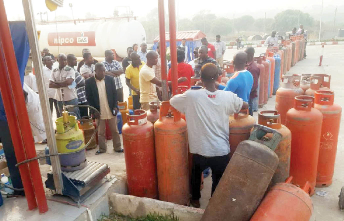
The persistent increase in the price of cooking gas is forcing many Nigerian households to abandon liquefied petroleum gas (LPG) for alternative cooking methods, as citizens grapple with the country’s rising cost of living.
Residents who spoke on the issue described the situation as increasingly difficult, with many turning to electricity, charcoal and firewood to cope with the soaring cost of gas.
Mrs Florence Oluwaseyi said her family has struggled to keep up with the rising price of cooking gas and has resorted to using an electric hot plate for some cooking activities.
“We have been coping, but it is not easy because the price is now very outrageous,” she said.
According to her, cooking with gas has become impractical for meals that require long cooking times, such as beans.
“We are using a hot plate because we have relatively stable electricity in our area. You can’t expect me to use gas to cook beans with the current price,” she said.
However, she noted that the alternative is not significantly cheaper. Living in a Band A electricity area, she explained that electricity units are quickly exhausted when using a hot plate.
“When we load ₦5,000 electricity, we get about 89 units. If I use a hot plate regularly, the units run out much faster. What should last a month may only last two weeks,” she added.
She appealed to the government to intervene by reducing the price of cooking gas to ease the burden on households.
Similarly, Mrs Oyinola Victoria said the high cost of gas has forced her to switch to charcoal, which she considers more economical.
“The price of gas has skyrocketed and it’s something I can’t cope with,” she said. “I now buy a bag of charcoal for ₦7,000 and some sell between N8,000 – N8,500. It lasts me for about two months. I can’t use ₦7,000 worth of gas for the same period.”
She described gas as too expensive for many families to sustain.
A gas and charcoal trader, Mrs Bukola Oladele, said the rising cost of cooking fuel has become a major challenge for average Nigerians.
“The high cost of cooking is beyond the reach of an average Nigerian, and gas is one of the worst affected,” she said.
Oladele, who works as a fashion designer, said economic realities pushed her into the gas retail business. As gas prices continued to rise, she expanded into charcoal sales to meet customer demand.
“I sell gas at about ₦2,000 per kilogram and a bag of charcoal for ₦8,000, but even these prices are becoming difficult for customers to afford,” she said.
Despite selling both products, Oladele said she does not use either for her household cooking because of the high costs. Instead, she relies on firewood sourced from her family’s farm.
“My husband farms, so we get firewood from the farm and bring it home. It is the most economical option for us because we get it free of charge,” she explained.
The trader urged the government to address the broader economic challenges driving up the cost of living, particularly the price of petroleum products.
“Petroleum is the cause of the high cost of living. If fuel prices come down, many other costs will reduce as well,” she said.
She also called for greater price regulation and standardisation to prevent arbitrary increases in the prices of essential commodities.
As economic pressures continue to mount, many Nigerians are increasingly turning to alternative cooking fuels, highlighting the growing strain that rising energy costs are placing on household budgets across the country.