
… says Ondo domestic debt drops 82.6% in 18 months
- Governor’s direct job creation unprecedented– CPS
• ‘Govt clears salary, gratuity arrears as health, education, roads, agriculture, power, security record major gains’
By Fisayo Akinduro & Precious Oluwole
Ondo State’s domestic debt profile has dropped by 82.6 per cent in the first 18 months of Governor Lucky Orimisan Aiyedatiwa’s administration, representing the highest percentage reduction recorded by any state in Nigeria.
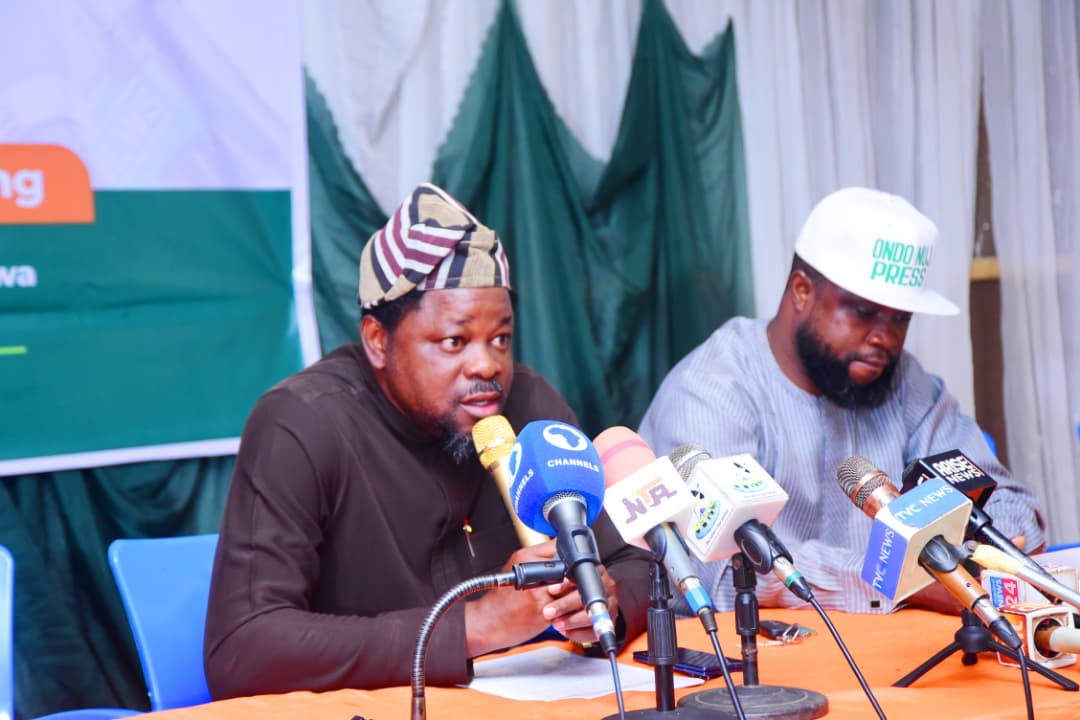
The Governor’s Chief Press Secretary, Prince Ebenezer Adeniyan, disclosed this on Friday at the maiden edition of the quarterly media briefing held at the NUJ Press Centre, Akure, where he presented the administration’s scorecard since Aiyedatiwa assumed office on February 24, 2025.
Adeniyan attributed the reduction to prudent financial management, fiscal discipline and effective debt management strategies, noting that the administration had also cleared all outstanding salary arrears owed to workers and former political office holders, as well as about 10 years of gratuity arrears owed to pensioners.
According to him, the measures had enabled the administration to pursue its “OUR EASE” agenda, centred on ease of living, ease of doing business, infrastructure, health, education, agriculture, security, youth and women empowerment, and public service reform.
“The central idea is to put the people first, deliver projects that matter and build a foundation for sustainable growth,” he said.
Adeniyan said the administration’s achievements over the period cut across healthcare, road infrastructure, education, urban renewal, water supply, power, agriculture, industrialisation, employment, workers’ welfare and security.
He said healthcare had remained a major priority, with the administration improving the remuneration of health workers to retain skilled personnel, expanding health insurance coverage to pensioners, pregnant women and other vulnerable groups, and upgrading infrastructure and equipment in hospitals and health centres across the state.
“More than 2,000 health professionals had been recruited, while Ondo State became the first state in the South-West to implement enhanced CONMESS and CONHESS allowances for health workers.
“Earlier this year, the State Executive Council approved a N1 billion Hospital Intervention Fund to expand and modernise healthcare facilities across the state.”
He said 100-bed capacity upgrades were ongoing at hospitals in Ikare-Akoko, Ore, Irele and Igbokoda, while more than 100 health centres had been renovated in less than two years.
“The University of Medical Sciences Teaching Hospital (UNIMEDTH) had also been equipped with a 1.5 Tesla MRI machine, a 160-slice CT scanner, 3D digital mammography equipment, 4D ultrasound machines, digital X-ray machines and other modern facilities.
“A pharmaceutical-grade warehouse in Akure had been completed to ensure a steady supply of medicines, while the Orange Health Insurance Scheme (ORANGHIS) had been expanded to cover public servants, workers in the informal sector and, for the first time, retirees and pensioners free of charge.”
The healthcare interventions, he said, had also produced improved outcomes, with the latest Nigeria Demographic and Health Survey ranking Ondo State as having the best under-five mortality indicators, while placing it among states with the lowest maternal mortality ratios.
“These achievements have been recognised at the national level,” he said, adding that Governor Aiyedatiwa had received the Best Governor in Health Transformation award bestowed on him by BusinessTimes in Lagos.
From healthcare, the administration’s intervention, according to Adeniyan, had extended to infrastructure, with road development being pursued to connect communities, improve livelihoods and position Ondo State for sustainable economic growth.
“More than 200 kilometres of roads had been completed within the last year and half, while a statewide 90-kilometre road rehabilitation programme was ongoing, with five kilometres allocated to each of the 18 Local Government Areas to ensure inclusive development,” he said.
He noted that the governor had also flagged off construction of the new Akure Flyover Bridge along Oyemekun-Oba Adesida Road to end decades of gridlock on the busy corridor at the heart of the state capital, while major urban roads in Akure, Ondo, Owo, Ikare and Ore had been rehabilitated and fitted with solar streetlights and drainage.
Adeniyan said three major intercity dualisation projects were also ongoing simultaneously across the three senatorial districts for the first time in the state: Akungba-Ikare Akoko in the north, Akure-Idanre in the central and Okitipupa-Igbokoda in the south.
According to him, the inherited Onyearugbulem-Irese Road flyover project in Akure had also been completed and commissioned, alongside other road projects inherited by the administration.
“Through the Rural Access and Agricultural Marketing Project (RAAMP) and state-funded projects, several rural roads linking farming communities to markets had been constructed and upgraded, cutting transport costs and reducing post-harvest losses.
“Public facilities were also being given facelifts, while concrete jetties and walkways were being constructed to improve transportation and ease movement for residents.
“The first phase of this was commissioned by the governor last month, while the second phase is ongoing,” he said.
The infrastructure drive, Adeniyan said, was complemented by interventions in education, where the administration’s policy focused on teacher recruitment, infrastructure development, student support, technical and vocational education, and digital learning.
“More than 2,000 teachers had been recruited, comprising 1,010 teachers for public secondary schools and 1,100 for primary schools.
“The administration had also revived and strengthened the free school shuttle initiative, with buses and boats conveying pupils to and from school daily.
“Student support programmes had been expanded through increased and regular payment of scholarships and bursaries to students in tertiary institutions.
“The government had also paid WAEC examination fees for public secondary school students to reduce the financial burden on parents, while books, tablets and sports equipment had been distributed to public primary and junior secondary schools across the 18 Local Government Areas.
“Earlier this month, Mr Governor increased the subventions to all tertiary institutions in the state by 60 per cent,” Adeniyan said.
He added that the administration had cleared all inherited salary arrears owed to staff of Rufus Giwa Polytechnic, Owo, and committed over N1 billion to the construction of a new Senate Building at the University of Medical Sciences, Ondo, among several other projects.
According to him, the administration’s efforts to improve the quality of life had also extended to urban renewal, public spaces and water supply, with Ondo State witnessing a wave of visible urban renewal driven by interventions in public spaces, water supply and urban planning.
The upgrade of Fasoranti Park, involving landscaping, walkways, lighting and supporting facilities, was restoring the park as a vibrant civic and recreational space for the capital city, while the first and second phases of the Light-Up project had commenced, with major roads in the state capital and major towns illuminated at night.
“A total of about 5,000 complete units of solar streetlights have already been installed,” he said.
The urban renewal initiative was further strengthened by the Akure Water Supply and Sanitation Project, a flagship component of the $223 million Nigeria Urban Water Sector Reform Programme, involving rehabilitation of waterworks, expansion of distribution networks and modern sanitation systems to deliver reliable water to households, public institutions and businesses.
After decades of neglect, the Owena Dam project was also receiving renewed attention under the Aiyedatiwa administration to improve water supply across the state.
“For the first time in decades, new water pipelines are being laid across the state,” Adeniyan said.
He added that the Omi Irorun Water Scheme had delivered more than 50 boreholes to rural communities.
The administration’s interventions in infrastructure and public utilities, he said, also extended to electricity, which remained a key pillar of the OUR EASE Agenda, with regulation, alternative energy, consumer protection and infrastructure development being combined while laying the foundation for state-level electricity generation.
Although independent power generation was still being developed, initiatives such as Light-Up, the Lucky Light Solar Programme, the O’Datiwa Mass Metering Programme and the establishment of a regulatory commission were already providing relief to businesses and households by reducing costs and improving electricity reliability.
The State Executive Council had also approved a US$1.6 million, 350-kilowatt hydropower project and a 7.5-megawatt gas-fired turbine to power government facilities across the state, while the administration had commenced distribution of transformers to communities to improve electricity supply.
Beyond infrastructure and utilities, Adeniyan said agriculture remained central to the administration’s economic development strategy, with the focus on large-scale investment, food security, value-chain development and farmer support.
The government was opening up large areas of farmland, attracting private investors, ensuring EU-compliant cocoa production for international markets and constructing rural roads to facilitate the movement of farm produce.
“Immediate interventions, including grain distribution and OSACA programmes, are helping to address food inflation and improve farmers’ welfare,” he said.
With more than N10 billion committed to agricultural development, the administration had continued to attract investors, while over 500 young people had been trained and empowered in modern agriculture.
The governor had also inaugurated the Ondo State Cocoa Revolution and Management Board to sustain the state’s position as Nigeria’s leading cocoa producer, while the State Strategic Committee on EU Deforestation-Free Regulation Compliance had been inaugurated.
In addition, 14,000 smallholder cocoa and oil palm farmers had been profiled under the FAO GEF-7 programme across eight Local Government Areas.
Adeniyan said the agricultural push was part of the administration’s broader economic transformation agenda, which also included industrialisation and efforts to attract major investments towards the development of the Ondo Deep Sea Port, refinery, Free Trade Zone and fertiliser plant, while supporting SMEs and agro-processing industries.
He said the administration’s policy reforms were designed to make Ondo State an attractive investment destination where businesses could operate with confidence, create jobs and diversify government revenue.
“These efforts contributed significantly to the return of the Dangote Group to the state, with plans to establish Nigeria’s largest industrial zone in Ondo State,” he said.
Several moribund industries were also being revived through Public-Private Partnership concessions.
The state had also signed several Memoranda of Understanding with investors, including a US$50 billion investment agreement involving Backbone Infrastructure Nigeria Limited and Sunshine Infrastructure JV, a 500,000 barrels-per-day refinery, a 1,471-hectare Free Trade Zone in Ilaje, and a US$4 billion petrochemical, fertiliser and cement project.
Adeniyan said the investment drive was being complemented by a job creation strategy centred on direct public-sector recruitment, skills development and enabling private-sector employment under the OUR EASE Agenda.
“It is on record that no governor has created more direct employment opportunities for the people of the state than Governor Aiyedatiwa,” he said.
More than 6,000 workers had been recruited in less than two years into critical sectors such as education, healthcare, security and agriculture to improve service delivery and reduce unemployment.
The administration had also implemented several skills acquisition programmes, including the O’Datiwa Skill-Up a Woman Initiative, which trained and empowered 1,000 women in tailoring, catering, ICT and other vocational skills, complete with start-up kits.
Through the One Youth, One Skill Programme, hundreds of young people had also been trained in various trades, while outstanding young entrepreneurs continued to receive government support.
Interest-free loans and grants had been given to market women, artisans and small business owners under the “Ondo Ease Fund”, while Adeniyan added that the governor had appointed more young people into government than any of his predecessors.
The administration’s economic and social interventions, he said, had also been matched by measures to improve workers’ welfare, with priority given to timely payment of salaries to civil servants, as well as pensions and gratuities to retirees, thereby maintaining trust and stability in the workforce.
“Workers now receive their salaries on or before the 25th day of every month,” he said.
After clearing all inherited salary arrears of civil servants, the governor had also cleared outstanding salary arrears of former political appointees in the state.
The beneficiaries, he said, were those who served under the administration of Dr Olusegun Mimiko as governor of the state between 2009 and 2017.
Pensioners were also receiving their monthly pensions alongside salary payments, while the government made deliberate monthly savings towards bulk defrayment of the backlog of gratuities.
“Under this arrangement, this administration has successfully cleared about ten years of outstanding gratuities,” Adeniyan said.
Other achievements in the sector included the upward review and payment of hazard allowance to health workers; implementation of tutors’ elongation of service from 35 to 40 years and from 60 to 65 years of age respectively; review of salaries and entry points of medical doctors; and full implementation of the workers’ Contributory Health Insurance Scheme.
As part of efforts to sustain the gains recorded across the various sectors, Adeniyan said the administration had adopted a multi-dimensional approach to security by strengthening the Amotekun Corps through improved facilities and stronger collaboration with other security agencies, while taking proactive measures against kidnapping and terrorism.
More than 100 operational vehicles had been distributed to security agencies to strengthen surveillance and improve response across identified flashpoints.
In addition, 500 new personnel had been recruited into the Amotekun Corps, while a modern Command and Control Centre had been established and fully equipped.
“Today, Ondo State remains one of the most peaceful states in the country,” Adeniyan said.
Earlier in his welcome address, the Chairman of the Nigeria Union of Journalists (NUJ), Comrade Leke Adegbite, commended the Chief Press Secretary to the Governor for maintaining a cordial relationship with journalists in the state.
He said the development was in line with the union’s agitation for the appointment of an indigenous journalist as the Governor’s Chief Press Secretary, noting that the appointment had strengthened the relationship between the government and journalists in the state.