
With Steve Otaloro
History is often unkind to institutions that forget the shoulders upon which they stand. The greatest tribute any organisation can pay to its pioneers is not merely by engraving their names on imposing buildings or instituting academic endowments in their honour, but by preserving the ideals and enduring legacies they laboured to build.
A few names command as much reverence in Nigeria’s banking history as Samuel Oyewole Asabia. A distinguished son of Idoani in present-day Ondo State, Asabia occupies a unique place in the annals of Nigeria’s financial sector as the first indigenous Managing Director of First Bank of Nigeria, assuming office in 1975 after serving as Deputy Governor of the Central Bank of Nigeria. His stewardship marked a defining era in the transformation of Nigeria’s oldest and most prestigious financial institution.
Asabia’s tenure coincided with one of the most significant policy shifts in the country’s banking industry. Under the military administration of General Olusegun Obasanjo, the Federal Government introduced the Rural Banking Programme, a bold initiative aimed at taking banking services beyond major cities into rural communities. The policy sought to deepen financial inclusion, mobilise rural savings, stimulate agricultural and commercial activities, and integrate millions of Nigerians in the informal sector into the formal financial system.
It was a visionary policy. It recognised that no nation could achieve balanced economic development if modern banking remained the exclusive preserve of urban centres. The village farmer, the rural trader, the artisan, the teacher and the civil servant all deserved access to safe and reliable banking services.
Among the communities selected under this national programme was Idoani.
During the 1980s, while Samuel Asabia was at the helm of First Bank, the bank established its Idoani Branch as part of the rural banking expansion programme. While there is no public evidence suggesting that the branch was established solely because Idoani was Asabia’s hometown, it is difficult to overlook the symbolic significance of Nigeria’s premier bank establishing a permanent presence in the hometown of its first indigenous Managing Director during his tenure.
Whether by coincidence or design, the branch became an enduring symbol of the philosophy that banking should belong not only to the privileged in the cities but also to ordinary Nigerians in rural communities.
Unlike many rural branches that commenced operations from rented buildings, FirstBank made a substantial investment in Idoani. The branch was purpose-built from the ground up. In addition, the bank constructed an official residence for the branch manager, providing suitable accommodation for whoever was posted to oversee the branch. These were not temporary investments. They reflected confidence in the future of the community and in the long-term value of rural banking.
For decades, the Idoani branch faithfully served not only the host community but virtually the entire Irekari LCDA and neighbouring settlements. Customers from Idogun, Imeri, Owani, Afo, Ikun, Oba and several adjoining communities relied on the branch for their daily banking needs.
The strategic importance of the branch extended beyond individual customers. Idoani is the headquarters of Irekari LCDA and hosts important federal institutions, including the Federal Government College, Nigerian Navy Secondary School Imeri. These institutions, together with farmers, traders, transport operators, cooperative societies, small businesses and public servants, generated substantial economic activities that required regular banking services.
The branch was therefore much more than a commercial outlet. It was an economic lifeline for an entire sub-region.
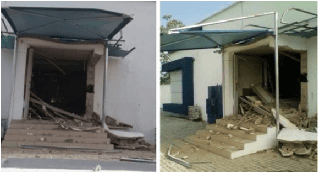
Then tragedy struck. On April 8, 2019, armed robbers launched a devastating attack on the FirstBank branch in Idoani. The incident resulted in the tragic loss of innocent lives and the theft of large sums of money. The entire community mourned, and the attack remains one of the darkest chapters in Idoani’s history.
No reasonable person discounts the seriousness of that incident or the security implications it posed. The safety of bank staff and customers must always remain paramount.
However, the unfortunate robbery should not have become the final chapter in the story of FirstBank in Idoani.
Following the attack, and coinciding with an internal branch rationalisation exercise undertaken by FirstBank to reduce the number of underperforming branches across the country, the Idoani branch was eventually closed. Whatever commercial considerations informed that decision, its consequences have been profound for the communities the branch faithfully served.
Thousands of loyal customers suddenly found themselves without a conventional banking institution. Residents now travel long distances to carry out basic transactions. Businesses incur additional costs simply to deposit or withdraw cash. Pensioners, traders, artisans, farmers and students have been left to depend largely on Point-of-Sale operators for services that were once readily available.
Meanwhile, the purpose-built banking hall and the manager’s residence- once symbols of confidence and development- now stand largely idle, gradually deteriorating through years of neglect.
One cannot help but wonder what Samuel Oyewole Asabia himself would think if he could witness this development.
Would a man whose leadership helped expand banking into rural Nigeria be pleased that the branch serving his own community and its neighbours has disappeared from the banking map?
To its credit, FirstBank has continued to preserve the memory of Samuel Oyewole Asabia in significant ways.
One of the most remarkable examples is the Samuel Asabia Professorial Chair of Business Ethics at the University of Lagos, established under FirstBank’s Education Endowment Programme in 1994 in honour of the bank’s first indigenous Managing Director. The Chair promotes research, ethical leadership and responsible corporate governance while mentoring future generations of business leaders.
That initiative deserves commendation. But if FirstBank considers Samuel Asabia worthy of a Professorial Chair at one of Nigeria’s foremost universities, should it not also consider him worthy of maintaining a FirstBank presence in the very town where he was born, nurtured and ultimately laid to rest?
There could hardly be a more fitting tribute than restoring banking services to Idoani through the reopening of the FirstBank branch established during the era in which Asabia led the institution. Such a decision would not merely honour a distinguished banker; it would reconnect the bank with one of the communities that best symbolises its own history and commitment to grassroots financial inclusion.
The reopening of the Idoani branch would transform Asabia’s legacy from one that is celebrated only in lecture halls into one that is experienced daily by ordinary Nigerians-the very people whose financial inclusion he helped champion.
This is not merely an appeal based on sentiment. It is an appeal founded on history, on corporate memory, on social responsibility and on the enduring values upon which FirstBank built its reputation over more than a century.
Every generation of leadership inherits institutions built by others. The men and women who occupy the highest offices at FirstBank today are custodians of a legacy they did not create but are privileged to preserve. Long before they arrived, Samuel Oyewole Asabia occupied that same office and helped lay the foundation upon which succeeding generations have continued to build.
One day, today’s management of the bank will also leave those offices. History will ask every one of them a simple question: What did you do with the legacy entrusted to your care?
They may not have ordered the closure of the Idoani branch, but history will judge whether they had the vision and courage to correct it.
Leadership is temporary. Legacy is permanent.
If there is one enduring lesson from the life of Samuel Oyewole Asabia, it is that true leadership is measured not only by the institutions one builds but by the opportunities one creates for generations yet unborn.
It is therefore not too late for the present management of FirstBank to revisit the decision to close its Idoani branch. Reopening the branch would restore vital banking services to thousands of people across Irekari LCDA and neighbouring communities while reaffirming the bank’s historic commitment to rural banking and financial inclusion.
More importantly, it would ensure that one of Nigeria’s greatest banking pioneers, the doyen of banking in Nigeria is honoured, not only in corporate headquarters and university lecture halls but also in the community where his remarkable journey began and where he now rests.
That would be a legacy worthy of Samuel Oyewole Asabia.
Otaloro is a public affairs analyst and lives in Akure, Ondo State. He can be contacted at steveoomania@gmail.com