
By Fatima Muraina
The Ondo State Government has distributed 37,500 indigenous tree seedlings to promote sustainable cocoa production and protect forest reserves across the state.
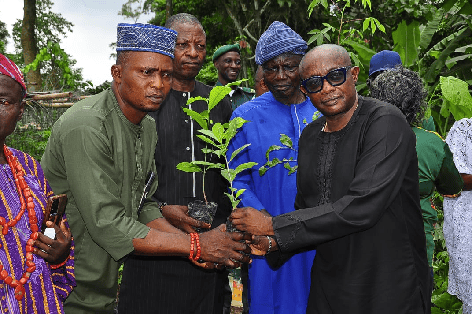
Governor Lucky Aiyedatiwa kicked off the distribution at Aponmu in Akure South Local Government area, describing the initiative as a major step towards restoring degraded forests and securing the future of the state’s cocoa industry.
Represented by the Commissioner for Agriculture and Forestry, Engr. Leye Akinola, the governor said the initiative underscores his administration’s commitment to sustainable agriculture through agroforestry.
He noted that Ondo remains Nigeria’s leading cocoa-producing state, accounting for more than 40 per cent of the country’s cocoa output, with about 350,000 hectares under cultivation.
Aiyedatiwa acknowledged that while cocoa farming has sustained rural livelihoods and boosted foreign exchange earnings, its expansion has also contributed to deforestation. He explained that integrating indigenous trees into cocoa farms would restore biodiversity, improve soil fertility, protect watersheds and strengthen climate resilience.
He added that the programme aligns with the European Union Deforestation Regulation, which requires cocoa exported to Europe to originate from land that has not been deforested since December 31, 2020.
According to him, compliance will position Ondo’s cocoa as a premium, sustainably produced commodity in the international market.
Describing the exercise as more than a tree-planting campaign, the governor said it is an investment in the state’s environment, economy and future generations. He urged beneficiaries to plant, nurture and protect the seedlings, stressing that the programme’s success depends on their survival.
Aiyedatiwa also defended the state’s adoption of agroforestry, saying increasing population pressure makes it impracticable to remove farmers from forest reserves. He explained that agroforestry has become a national and state policy aimed at balancing agricultural production with environmental conservation.
He said farmers would be encouraged to cultivate cocoa alongside indigenous species such as Obeche, Afara, Iroko, locust bean and ogbono trees. Besides improving biodiversity, the economic trees would provide additional sources of income for farmers.
The governor also disclosed that farmers who maintain shade trees on their cocoa farms stand to benefit from emerging carbon credit opportunities. He said Nigeria is positioning itself to access the global carbon market, enabling farmers who preserve trees to earn additional income in foreign currency.
He directed the Ministry of Agriculture and Forestry to ensure strict compliance with the December 31, 2020, cut-off date during verification and seedling distribution, while strengthening agroforestry extension services across cocoa-producing communities. He also commended development partners, traditional rulers and community leaders for supporting the initiative.
Speaking at the event, the Chairman of the Association of Timber Dealers and a traditional ruler urged farmers to embrace tree planting, noting that economic trees offer significant long-term financial returns.
He said a mature Obeche or Afara tree could fetch at least ₦150,000 after about 15 years while also contributing to environmental sustainability.
Earlier, the Commissioner for Agriculture and Forestry, Engr. Leye Akinola, represented by the Permanent Secretary Forestry and Natural Resources Mr Bosun Adedipe, said the seedlings distributed include Mansonia, Mahogany, Ceiba, Parkia (Iru), Terminalia superba (Afara) and other indigenous species.
He disclosed that three nursery sites had been established at the Akure Forest Reserve, OA4 Forest Reserve and OA3A Forest Reserve, with additional sites planned across the state. He said the nurseries would ensure farmers have easy and continuous access to quality seedlings.
According to him, farmers operating in designated restoration zones will receive up to 300 seedlings per hectare. He assured them that technical teams would monitor planting to ensure the seedlings are established within mapped cocoa farms and properly maintained.
Speaking on behalf of the farmers, the Chairman of the Ondo State Agricultural Commodities Association, Chief Abiodun Adejo, commended the government for the initiative.
He urged farmers to embrace tree planting, describing it as essential not only for economic prosperity but also for environmental sustainability and human survival.
Adejo said planting trees helps preserve life by producing oxygen and improving the environment. He encouraged farmers to dedicate part of their land to tree planting, expressing confidence that the programme would strengthen cocoa production, improve livelihoods and protect Ondo State’s forest resources for future generations.