
By Fatima Muraina
The Ondo State Government has pledged sustained support for women farmers and agribusiness entrepreneurs, with a commitment to improving their access to productive resources, finance, technology and markets.
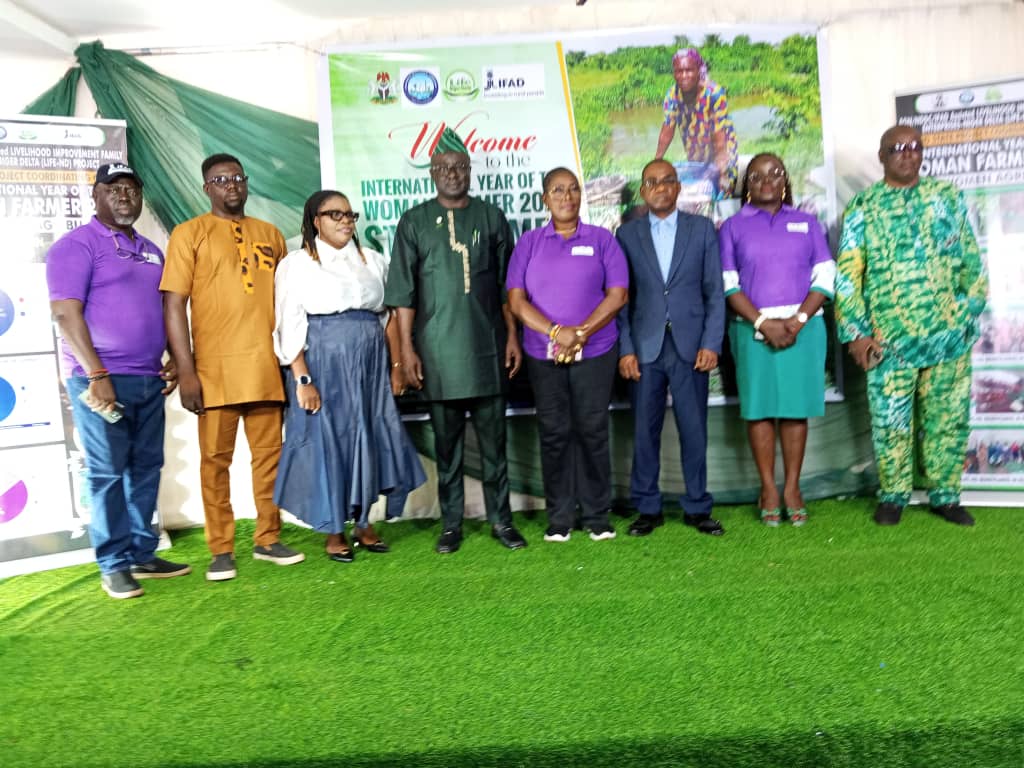
The state Commissioner for Agriculture and Forestry, Engr. Leye Akinola, made the pledge at the 2026 International Year of the Woman Farmer State Women Agribusiness event organised by the Federal Government’s Livelihood Improvement Family Enterprises in the Niger Delta (LIFE-ND) Project in Akure.
The event, which had the theme, “Empowering Women, Strengthening Agribusiness, Building Resilient Communities,” also featured the recognition and presentation of awards to outstanding women farmers.
Akinola said the state government was committed to working with relevant stakeholders to build an agricultural sector where women farmers would be recognised, empowered, adequately supported and fully represented in agricultural decision-making processes.
He said women remained central to agricultural value chains, contributing significantly to production, processing, marketing, storage and household nutrition.
“Women farmers are central to our agricultural value chains. From production and processing to marketing, storage and household nutrition, women continue to play critical roles in sustaining our food systems.
“Yet, despite these contributions, many women farmers still face challenges, including limited access to land, finance, agricultural inputs, modern technology, extension services, markets and decision-making opportunities,” he said.
The commissioner said the state government recognised that agricultural transformation could not be achieved without the meaningful inclusion and empowerment of women farmers.
According to him, the government would continue to support policies and programmes that promote gender-responsive agricultural development, improve women’s access to productive resources and strengthen their participation in agricultural value chains.
He added that the government would create more opportunities for women to thrive as entrepreneurs and leaders in the agricultural sector.
Akinola also assured that the state would continue to meet its counterpart funding obligations to the LIFE-ND Project to sustain its impact on young people and women involved in agricultural value chains across the state.
“Let us work together to ensure that women farmers have the resources, skills, technologies, finance and institutional support required to increase productivity, add value to their produce and access profitable markets,” he stressed.
Earlier, the LIFE-ND State Project Coordinator, Dr Olawale Ademola, said the United Nations, through the Food and Agriculture Organisation (FAO), had declared 2026 the International Year of the Woman Farmer to celebrate the contributions of women across the agricultural value chain.
Ademola said women played vital roles in production, processing, marketing, technology, administration and policymaking, stressing that their contributions were critical to sustainable food security.
“Without women in the system, the system will be incomplete. The women are involved in production, processing, marketing, technology, administration, policymaking and all other areas.
“We cannot do without them. Looking at their efforts, contributions and support in ensuring sustainable food security, they have to be celebrated. So, we are celebrating our women all over the world,” he said.
He urged women, particularly young women, to embrace agriculture as a commercial venture rather than viewing it merely as backyard farming.
“Agriculture is no longer just about having a garden in the backyard, planting and consuming everything. Today, we are talking about agribusiness and being in the sector commercially,” Ademola said.
He disclosed that more than 4,000 women had benefited directly from the LIFE-ND Project, adding that beneficiaries had recorded improvements in their economic wellbeing.
Also, the Ondo State Coordinator of the Federal Ministry of Agriculture and Food Security, Mr Rufus Agbanimu described women as the backbone of food security, drivers of rural economic growth and architects of agricultural innovation.
Agbanimu , who was represented by Mrs Olatoke Olufunmilola said women farmers were contributing to the sustenance of families, local commerce and community development, while increasingly moving from subsistence farming into high-value processing, distribution and global trade.
He however, called for urgent measures to address challenges limiting the potential of women farmers, particularly inadequate access to finance, land ownership and security, modern technology and agricultural modernisation.