
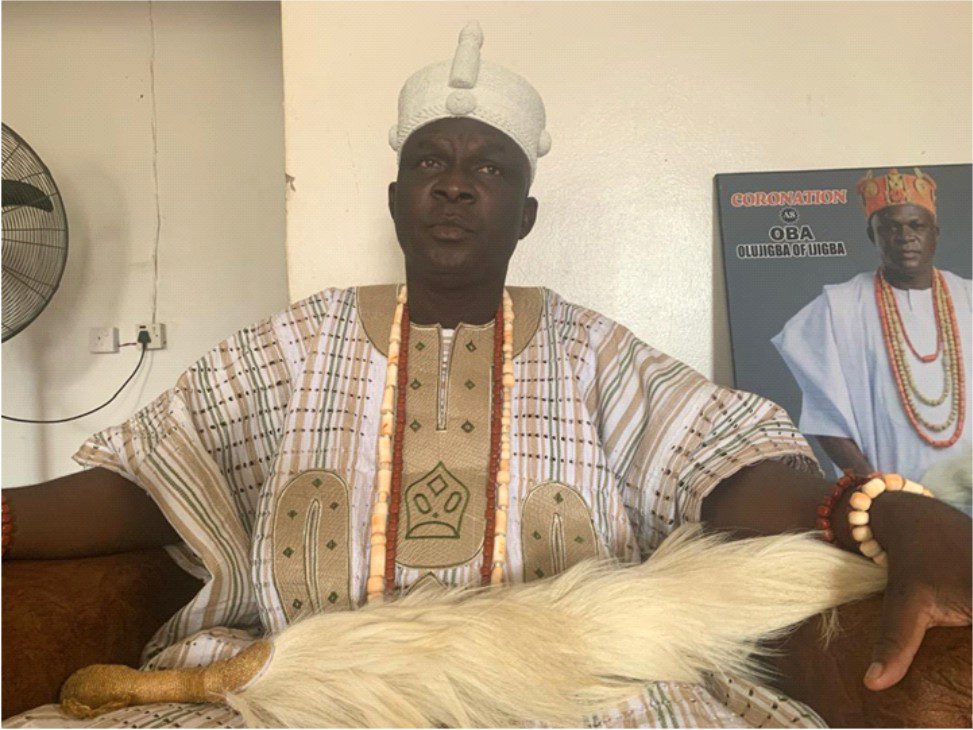
The newly installed Olujigba of Ijigba, Oba Omotayo Ajisegiri, Sarebi I, speaks with our reporter, Ayodele Popoola on his vision for the kingdom and his priorities for the years ahead. He discusses the urgent need for improved roads and healthcare facilities, youth empowerment and job creation, community security and stronger collaboration between traditional institutions and government. Excerpts:
What are your priorities for developing Ijigba, and what would you like the government and people to achieve in the next five to ten years?
First, I give all glory to God Almighty, the One who gives royalty and makes it possible for a person to ascend the throne. I thank God for giving me the grace to reach this throne. I also appreciate everyone God used in various ways to make my emergence possible, especially those who supported me financially and materially.
Regarding my aspirations for my people, I have many plans for the development of Ijigba Kingdom. One of my major priorities is to develop areas where the community lacks infrastructure and other basic amenities.
There are certain things that people have always depended on the government to provide, but which individuals and the community can also contribute to. Wherever we have the capacity to act, we will do so.
For instance, we can construct small bridges and carry out other minor infrastructure projects. We will also look at the road network and other areas where we can make meaningful interventions.
However, where a project is beyond our financial capacity, we will appeal to the government for assistance. There are areas around the community that could endanger the lives of our people or negatively affect their well-being. Those are areas where we will immediately seek government intervention.
On healthcare, security and other social amenities, we will also do what is within our capacity, together with my chiefs and the people of the town.
I recently visited our healthcare facility and maternity centre, and I observed that there are things that need to be improved. We need fencing, better security and other basic infrastructure to ensure that the nurses, other healthcare workers and patients feel safe.
Looking at the various issues affecting communities in Ondo State, particularly your local government areas, what are the major things you would like His Excellency, the Governor of Ondo State, to do for the people of this community?
His Excellency, the Governor of Ondo State, Hon. Lucky Aiyedatiwa has done very well, particularly in the area of infrastructure. He is one of the governors who have performed creditably in the state.
His administration has also helped reduce road traffic accidents through improvements in the road network, and we appreciate that. We pray that God will grant him long life and continue to give him the strength to serve the people.
However, we still have challenges with our roads.
As I said earlier, there are some things that are within our capacity to address, such as constructing small bridges. But there are major roads that are completely beyond our capacity.
We appreciate the road projects the government has embarked upon, including the dual carriageway projects in other areas. Anyone travelling through those areas knows the difficulties people experience day and night.
We are, therefore appealing to His Excellency to extend similar road projects to our communities.
The road from Ijigba to Atipere is particularly bad. When it rains, it becomes extremely difficult for people to pass through. The condition is so bad that vehicles can even slide into people’s houses.
This is not something the local community can handle alone. We, therefore appeal to our governor, whom we regard as a merciful father, to look into the condition of our roads and come to our aid.
The road network is our most pressing need.
We are grateful for some of the projects already undertaken, including the community facilities and water projects. We pray that God will continue to give the government the strength and resources to do more.
But, above everything else, the road network is the most urgent issue.
Kabiyesi, another major issue concerns our youths. We have many young people in our community, and youth unemployment is a serious national problem. Some young people become involved in criminal activities or engage in harmful practices because they have no means of livelihood.
As a traditional ruler, what are your plans for addressing this problem?
I have always maintained that our youths must be encouraged to work and acquire skills.
I have repeatedly told them, “Go and learn a trade.” Parents should encourage their children to learn a trade if they are not going to school. They should not prevent their children from acquiring useful skills.
Those who want to study should go to school. But I do not want anyone to remain idle.
Even I, as the king, am a businessman and I work. If the king works, the child of an ordinary citizen should not say that he or she will not work.
We must lead by example.
I have warned our youths against engaging in criminal activities. If we give young people meaningful opportunities and responsibilities, they will be less likely to use their strength and energy for destructive purposes.
We need to encourage them to wake up early and find something productive to do.
What support systems are in place to help youths who want to work but lack the financial means to learn a trade or start a business?
We have been empowering people for a long time, and we will continue to do so.
Anyone who learns a trade, whatever that trade may be, if I have the financial capacity, I will provide the equipment they need to start working.
If the equipment or support required is beyond my financial capacity, I will write to the government and appeal for assistance for our youths.
I do not want our young people to become notorious armed robbers or engage in other criminal activities simply because they lack opportunities.
That is why I keep telling them to go and learn a trade.
Once I have the capacity, I will support them. Sometimes, I can assist two or three people in a day.
The important thing is that they must first be willing to learn and work.
We will appeal to the government for projects and empowerment programmes that are beyond our capacity, but whatever we can afford to do ourselves, we will do.
How can the government support and formally recognise local hunters to help improve security and combat kidnapping, farm attacks, and other crimes in our communities?
The government should support these local hunters. If a police officer is posted to an area where he has never lived, he cannot know the terrain the way a local hunter does. The local hunter knows the area during the day and at night. He knows the forests, farms, roads and various routes within the community.
As President Tinubu said, those who live in a place are the ones who can best protect that place. Therefore, the government should encourage these local hunters by providing them with financial support and, where possible, putting them on a regular payroll or stipend.
The person who is risking his life to protect the town also needs to be supported. We should not expect someone to put his life at risk without providing him with the necessary support.
The government also needs to ensure that those protecting our communities are adequately equipped. How can you expect someone with an ordinary local gun to confront criminals who are carrying sophisticated weapons? There is a serious imbalance.
We should therefore appeal to the government to provide these community security personnel with the necessary equipment and support so that they can perform their duties effectively.
There are also traditional ways of strengthening their commitment to the community. Our traditional institutions have methods of ensuring loyalty and dedication. The government should work with traditional rulers to establish a system that will encourage these local security personnel to remain committed to protecting their communities.
They already know the terrain. They know the people, the forests and the routes. If properly supported, they can work effectively alongside the police and other formal security agencies to protect our communities.
What about the traditional institution itself? Do you believe traditional rulers should have greater constitutional recognition and a more defined role in community security?
Yes. I believe traditional rulers should be given greater recognition and responsibility.
Traditional rulers are very close to their people. We know our communities and the people living in them.
There are traditional methods and community structures that have been used for generations to maintain peace and protect communities. These should not simply be discarded.
The government should recognise the role of traditional rulers and give them the respect and authority necessary to contribute meaningfully to the security and development of their communities.
At the same time, everything must be done within the law and in cooperation with the formal security agencies.