
…as Ondo mobilises 2,000 volunteers for community devt
* UN agencies, NDE seek investment in youth, skills development
By Fisayo Akinduro & Precious Oluwole
Ondo State Governor, Hon. Lucky Orimisan Aiyedatiwa, including his Osun and Benue counterparts, Senator Ademola Adeleke and Rev. Fr. Hyacinth Alia have called for stronger institutional support, coordinated partnerships and sustained investment in volunteerism as a strategy for national development.
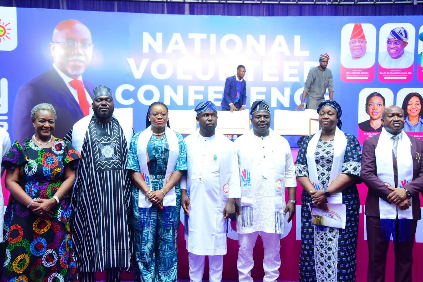
The governors made their positions known at the 2026 National Volunteer Conference held at the Dr Olusegun Mimiko Event Centre, Akure, on Friday, where government representatives, the United Nations, educational institutions and other stakeholders advocated a structured approach to voluntary service.
Aiyedatiwa disclosed that more than 2,000 volunteers had been mobilised in Ondo State to support health, education, skills development and other community initiatives.
Represented by the Commissioner for Physical Planning and Urban Development, Sunday Olajide, the governor said volunteerism must be backed by deliberate policies, effective coordination, appropriate institutions and government support to deliver sustainable results.
He said, “Volunteerism should not just be seen as a realm of abstract thinking, but it should be something that is practicable, something we can see, something we can feel.”
The governor explained that the Ondo State Volunteer Service was established to provide an institutional framework for citizens to contribute their time, talents, knowledge, skills and resources to the state’s development.
“Development of any society cannot be left to government alone. It is a collective responsibility,” he said, stressing the need for collaboration among government, the private sector, civil society organisations, development partners, traditional and religious institutions and citizens.
Aiyedatiwa urged schools, tertiary institutions, youth organisations, professional associations, businesses and development partners to establish structured opportunities for young people to volunteer, acquire skills and develop leadership capacity.
He said, “We must, therefore, encourage our young people to see volunteerism not as a distraction from their aspirations, but as an opportunity to develop themselves while contributing to the common good.”
He described the conference, held to commemorate the International Year of Volunteers for Sustainable Development proclaimed by the United Nations General Assembly, as an opportunity to strengthen collaboration among federal and state governments, UN development partners, civil society organisations, voluntary organisations, the private sector and academic institutions.
The governor urged participants to develop practical recommendations for strengthening volunteerism at national, state and community levels, adding that the success of the conference should be measured by the positive changes resulting from its deliberations.
“The true strength of a society lies not only in the resources available to it, but also in the willingness of its people to use their talents for the common good,” he said.
Quoting the Junior Chamber International’s motto, he added: “Service to humanity is the best work of life.”
Aiyedatiwa commended the Ondo State Volunteer Service and the conference organising committee for bringing together stakeholders committed to volunteerism and sustainable development.
On his part, Osun State Governor, Senator Ademola Adeleke, represented by the Director-General on Climate Change and Renewable Energy, Prof. Chinwe Obiaku, described volunteerism as vital to national development, peace and social cohesion.
He commended the United Nations Development Programme (UNDP) for promoting voluntary service, noting that it complemented government efforts to provide essential services while enabling young people to acquire practical skills, teamwork and leadership experience.
The Osun governor called on governments, businesses, educational institutions and civil society organisations to expand accessible and well-coordinated volunteering opportunities in education, healthcare, environmental protection and skills development.
He urged stakeholders to make concrete commitments to sustain volunteerism and improve lives across communities.
Similarly, Benue State Governor, Fr Alia called for stronger partnerships among governments, the United Nations, the private sector and civil society to expand opportunities for young people to acquire skills, serve their communities and contribute to national development.
Represented by the Director-General of the Benue State Bureau for International Cooperation and Development, Dr Aondoaseer Leonard-Angelo Viashima, the governor said volunteerism supported youth empowerment, skills development, job creation and human capital development.
He said it aligned with President Bola Ahmed Tinubu’s Renewed Hope Agenda and could equip young Nigerians with practical skills, vocational knowledge and resources for community-building, while helping communities address insecurity, displacement and economic recovery.
Alia, however, stressed that governments must remain accountable for their responsibilities even as volunteerism extended the reach and impact of development efforts.
He reaffirmed Benue State’s commitment to supporting volunteerism and urged stakeholders to build a nation where every talent found opportunity, every act of service created value and every contribution mattered. He also prayed for God’s blessings on Bayelsa State and Nigeria.
On his part, the Vice-Chancellor of the University of Abuja, now Yakubu Gowon University, called for a coordinated national approach to harness Nigerians’ skills towards achieving the Sustainable Development Goals (SDGs) by 2030.
He said Nigeria needed “a renewed ethic of service, solidarity, responsibility and practical citizenship”, noting that public institutions alone could not achieve the goals.
The vice-chancellor said effective volunteerism required training, coordination, supervision, institutional support and measurable outcomes, stressing that voluntary contributions must address genuine community needs.
“Every contribution matters,” he said, urging stakeholders to make the principle a national development priority rather than a conference slogan.
He cited Nigeria’s estimated population of 237.5 million in 2025, including a significant young and working-age population, as a major opportunity for development through volunteering.
He noted that Africa recorded the highest global volunteer engagement, much of it informal through families, religious organisations, professional groups and student bodies.
He called for stronger coordination among government, civil society, universities, businesses and the Nigerian National Volunteer Service.
To protect volunteers from exploitation, he advocated accreditation, safety guidelines, insurance and impact assessment, particularly to prevent volunteering from being used as a substitute for paid employment.
He said universities could integrate volunteering into teaching, research and community service, allowing students to support literacy, healthcare, legal assistance, agriculture, small businesses and infrastructure development under professional supervision.
The vice-chancellor also advocated inclusive and intergenerational volunteering involving women, persons with disabilities, rural residents, economically disadvantaged people and retirees.
He identified transport, meals, accessibility arrangements, insurance and protective equipment as necessary support for vulnerable volunteers and those exposed to health risks.
He added that volunteering could strengthen citizenship, social cohesion, leadership and employability while complementing, rather than replacing, qualified professionals. He urged stakeholders to connect voluntary service with climate action and community resilience through structured training, supervision and appropriate duty-of-care arrangements.
Also speaking, the National Directorate of Employment (NDE) also urged Nigerians to embrace volunteerism to address unemployment, poverty and skills deficits.
Its Director-General, Silas Ali Agara, represented by the Director of Inspectorate, Mrs Steve-Ogundipe Olayinka, said volunteering would enable young people to gain practical experience, develop leadership skills and contribute to community development.
He commended the United Nations Volunteers Programme and its partners for promoting inclusive development and the SDGs.
Agara reaffirmed the NDE’s commitment to skills acquisition, entrepreneurship development and employment generation, stressing that volunteerism could complement government efforts to create sustainable livelihoods.
In his welcome address, the Senior Special Assistant to the Ondo State Governor on Volunteer Services, Charles Iwakun, said volunteerism built character, developed leadership and strengthened communities.
He disclosed that a volunteer summit held last year attracted more than 2,000 volunteers across health, education, skills development and other sectors.
He also highlighted initiatives involving legal volunteers, educational and health support, as well as the National Volunteering Service launched in 2026.
Iwakun appreciated the governor, the United Nations and volunteers for supporting inclusive development.
Also, the Country Coordinator of the United Nations Volunteers Programme in Nigeria, Ms Veronica Obiuwevbi, called for greater recognition, protection and investment in volunteerism as an instrument of national development.
She said volunteers contributed to health, education, peacebuilding, humanitarian action, youth empowerment and the SDGs by connecting institutions with communities.
Obiuwevbi recalled the UN’s proclamation of the International Year of Volunteers in 2001 and the 60th anniversary marked in 2011, adding that the 2026 World Conference had renewed calls to strengthen volunteerism.
She thanked the Ondo and Bayelsa State governors for their support and urged stakeholders to ensure volunteers were valued, equipped, protected and given opportunities to contribute to national development.
The United Nations Population Fund (UNFPA) called on federal and state governments to formalise youth volunteer recognition and training and allocate dedicated budgets for youth-led initiatives.
The UNFPA Resident Representative, Ms Muriel Mafico, represented by the South-West Sub-Office Head, Ms Abbigail Msemburi, said more than 60 per cent of Nigeria’s population was under 25, describing young people as agents of change.
She advocated inclusive volunteering targeting young women and persons with disabilities, highlighting UNFPA’s youth participation platform for policy design, programme delivery and grassroots outreach.
Msemburi urged stronger partnerships, integrity and sustained investment to tackle gender inequality and build a safer, healthier and prosperous Nigeria.
The World Health Organisation (WHO) also called on governments and stakeholders to invest in, protect and recognise volunteers to achieve health for all by 2030.
WHO Country Representative, Dr Pavel Ursu, represented by the Osun State Coordinator, Dr Ojediran, said more than 4,000 volunteers had supported community health across Nigeria’s 36 states and the Federal Capital Territory in eight years.
He said volunteers strengthened disease surveillance, immunisation, maternal and child healthcare, outbreak response and access to healthcare for vulnerable populations, stressing the need for training, safety, equipment, support and recognition.
At the event, a special recognition award was presented to Governor Aiyedatiwa. Others honoured included the Proprietress of Mummy’s Place Nursery and Primary and Emplace College, Akure, Dr. Damilola Oshin and the Chief Press Secretary to the Governor, Prince Ebenezer Adeniyan.