
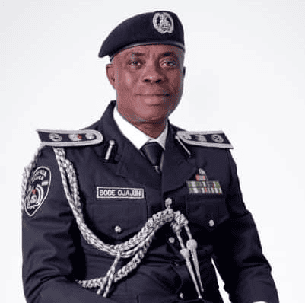
The Ogun State Commissioner of Police, Olabode Ojajuni, has attributed his disciplined lifestyle, strong work ethic and zero tolerance for corruption to the moral values instilled in him by his late father.
Ojajuni, who hails from Igbotako in Okitipupa Local Government area of Ondo State, speaks exclusively with Tola Gbadamosi, Senior Crime Reporter of THE HOPE Newspaper, discussing his upbringing, policing strategies in Ogun State, the fight against kidnapping, inter-agency collaboration, state police, criminal justice administration and his plans for retirement, among others.
Excerpts:
A recent publication highlighted the role your late father, who was said to be a disciplinarian, played in shaping your life. Can you shed more light on this?
Your parental background is the foundation upon which you build your life. Whether you become disciplined, successful or responsible largely depends on the values instilled in you while growing up.
My late father was a teacher and also a disciplinarian. He gave me a very strong moral foundation, and I have always tried to live up to the values he taught me.
There is a saying that when you are brought up by a teacher, you must also continue to teach yourself and improve yourself. That is what I have tried to do throughout my life.
Let me give you one or two examples.
Apart from what I recently told the public about never demanding or collecting a bribe, I remember an incident involving a loan I obtained from the police cooperative. My mother refused to collect the money from me until I returned to Lagos and brought the certificate of indebtedness. I had to return a week later with the document before she accepted the money.
Another reason I developed a strong hatred for corruption was what I witnessed after my father retired from the Ondo State Civil Service.
Some corrupt civil servants continued to demand money from retired workers before performing duties they were officially paid to perform. They demanded money for certificate verification, document verification and other official responsibilities.
The retired workers eventually formed an association and contributed money to meet these demands. Whenever my father returned home, he would tell us about the officers who were demanding money and those who were doing their jobs without asking for bribes.
That experience affected me deeply.
Corruption is not limited to money. It can take different forms, including demanding gifts or other benefits in exchange for performing an official duty. If you are paid to perform a duty and you demand additional gratification before performing it, that is corruption.
What happened to my father made me hate corruption, particularly corruption in the public service.
At a point, I realised that over two or three years, the money extracted from my father by these officials was probably more than the gratuity he received. That was my first real experience with corruption, and it made a lasting impression on me.
Another incident occurred after my father died.
Some members of the association of retired civil servants came to me and advised me not to inform the government immediately about his death so that his pension could continue to be paid.
I thanked them, but I did not accept the suggestion.
The following day, I obtained my father’s death certificate. I went to his bank and presented the certificate, asking them to stop his pension. I also went to the ministry and informed them of his death.
I did that because of the values my father had taught me.
My father was also a lay preacher in the Methodist Church. He was well known in the Igbobini Diocese and preached in many places.
Interestingly, my grandfather, Samuel Ojajuni, popularly known as Saseho, was one of those who brought the Methodist Church to our hometown in 1914. At that time, access to Igbobini was largely through Lagos because of the waterways.
He became the first Baba Ijo of the Methodist Church in our community. Today, I am also proudly a Baba Ijo. Whenever I remember that I have stepped into the shoes of my grandfather, I feel very proud and fulfilled.
You were once the Police Public Relations Officer in Lagos State. How would you compare your experience there with your present responsibility in Ogun State?
There is really no basis for comparison because the Nigeria Police Force is a regimented organisation with clearly defined responsibilities.
At the time I served as Police Public Relations Officer in Lagos, I performed the duties assigned to that position.
Today, I am Commissioner of Police in Ogun State, so I am performing the responsibilities of a Commissioner of Police.
The police have manuals and documents defining the responsibilities of officers at different levels. Whether you are a Police PRO, Divisional Crime Officer, Divisional Police Officer, Area Commander, Commissioner of Police or Assistant Inspector-General of Police, there are clearly defined duties.
So, for me, it is simply a matter of deployment and responsibility.
Kidnapping and other forms of insecurity have attracted considerable attention in Ogun State. How have you been able to contain the situation?
Crime has existed from the beginning of human society. As society evolves, crime also evolves. The pattern and threats change, and the police must study those changes and respond appropriately.
There was a time armed robbery was prevalent. Today, kidnapping has become a major concern because criminals believe they can make more money through ransom.
In the past, criminals might have needed to rob a bank or a company to obtain huge sums of money. Now, through kidnapping, they can demand N30 million or N50 million.
Ogun State has had its fair share of kidnapping, but the positive thing is that in the cases recorded in the state, victims have been rescued. We have made arrests, recovered weapons and neutralised some criminals.
When students of a polytechnic in Ogun State were kidnapped, Governor Dapo Abiodun approached the Inspector-General of Police, who deployed a helicopter to assist in the operation. The students were rescued without payment of ransom.
We also had a situation where five students were kidnapped, and they were rescued promptly.
Our success depends on several factors: studying the crime pattern, availability of operational assets, technology, intelligence, commitment, professionalism and training of personnel.
As police officers, we are expected to think ahead of criminals. We are trained to anticipate threats and act proactively.
Intelligence gathering is particularly important. We engage communities because the people are major sources of information. When we receive actionable intelligence, we act on it.
Where a crime has already been committed, we ensure that the perpetrators are arrested and prosecuted so that justice can be served and others are deterred.
Kidnapping is now a national phenomenon, and the Nigeria Police Force has a central technical structure in Abuja. When necessary, specialised departments and personnel are deployed to support state commands.
They analyse intelligence, provide technical support and deploy equipment where necessary.
All these mechanisms are helping us in the fight against kidnapping, and I believe we are winning.
What is your assessment of the judiciary and its handling of criminal cases in Ogun State?
The judiciary is an independent institution, but we collaborate closely with it.
In Ogun State, we have a very robust relationship with the judiciary. The criminal justice system begins with the police. We make arrests, investigate and hand over cases to the next stage, which is the judiciary.
The Director of Public Prosecutions and other legal officers also play important roles. In Ogun State, they have been very responsive in providing legal advice to the police. When we identify cases involving serious criminal elements, such as cult members, they examine the facts and advise appropriately.
The judiciary also considers the merits of each case before making decisions.
After the judicial process, the correctional system comes in. Those convicted are sent to correctional facilities, where they are expected to undergo rehabilitation.
Some people are reformed and return to society, while others unfortunately return to crime. When repeat offenders are arrested and taken back to court, they may face stiffer penalties.
So, the Ogun State Police Command and the judiciary work together within the law to keep the state safe.
How would you rate the performance of the Ogun State judiciary in terms of speedy dispensation of justice?
I would rate its performance as fantastic. The judiciary has performed optimally, with the support of the state government.
The Ogun State Government has been very supportive of our operations, while the Inspector-General of Police has also provided tremendous support.
Let me give you an example.
About two months ago, we conducted an operation that involved combing the forest belt from Lagos through Ogun State towards Oyo State.
It was initiated by the Inspector-General of Police, and the governors of Lagos and Ogun States embraced the initiative and provided logistics and other support.
The two state commands worked together in what became “Operation Kosaye.”
The operation covered areas from Ojodu and Epe in Lagos into Ogun State, including Ijebu-Ode, Ogbere, Ilaro, Owode-Egba and Ayetoro, extending towards the Oyo State axis.
We swept the forest areas, destroyed criminal camps, arrested suspects and rescued kidnapped victims. In all, 88 criminals were arrested, while some suspects were prosecuted and remanded.
The operation was supported by the two state governments, and the people of Lagos and Ogun also supported us. Vigilantes, Amotekun and hunters participated.
The objective was to ensure that criminals could not use the border areas between Lagos and Ogun as safe havens.
I want to use this opportunity to appreciate the Governor of Ogun State, Prince Dapo Abiodun, who has been a father and a pillar of support to the command. I also appreciate the Inspector-General of Police, IGP Olatunji Disu, for his support.
How does the police collaborate with other security agencies such as the NSCDC and the Army?
We work together as one body. In Ogun State, there is a security structure involving the various service and security chiefs, and as Commissioner of Police, I chair that structure.
We conduct joint operations, hold regular meetings, review security situations and assess previous operations.
We also plan proactively and jointly develop strategies to address emerging threats.
Beyond official engagements, we also have social interactions that help deepen interpersonal relationships among the heads of the various security agencies.
That has strengthened inter-agency cooperation in Ogun State.
What is your view on the proposed establishment of state police and how it would work with the Nigeria Police Force?
When IGP Olatunji Disu assumed office, a State Police Steering Committee was established, and I was privileged to serve as the secretary of that committee.
We worked on the document and the Inspector-General presented it to the National Assembly. That gave me an opportunity to understand the framework being proposed.
The document clearly defines the responsibilities of the federal police and those of the proposed state police.
The state police is not supposed to be a rival to the Nigeria Police Force. Rather, it is expected to complement the efforts of the federal police.
However, the process is still ongoing and the final document is subject to legislative consideration and inputs from the various stakeholders. So, I would not want to pre-empt the final outcome.
But the general philosophy is that state police should complement, not compete with, the Nigeria Police Force.
Since your assumption of duty as Commissioner of Police, what have you done differently in Ogun State?
Before I became Commissioner of Police, I served as Deputy Commissioner of Police in charge of the Criminal Investigation Department in Ogun State.
I was later posted to INTERPOL as Commissioner of Police.
So, I understand the terrain, the people and, to some extent, the psychology of criminals in the state.
The crime pattern has changed slightly from what I experienced when I was previously in Ogun State. We have been addressing emerging challenges.
One area that previously gave us serious concern was sexual offences, particularly the defilement of minors.
There were cases where minors were abused by adults because of the false belief that such acts could bring money or fortune. That is a fallacy.
Through enforcement, advocacy and sensitisation, we have been able to reduce such offences.
Ritual killings have also reduced significantly as a result of advocacy and sensitisation. We continue to tell people that they cannot make money through ritual practices.
Cultism remains a national problem. We continue to educate young people that cultism adds no value to their lives. When you join a secret organisation that you cannot openly identify with, you have essentially mortgaged your freedom and future.
The state government’s amnesty programmes have also encouraged some cult members to renounce their membership. Many have been rehabilitated with the assistance of government, NGOs and religious organisations.
Land grabbing is another challenge in Ogun State because of its proximity to Lagos. Many people come into Ogun to acquire land for residential and industrial development.
Ogun is also becoming an industrial hub, attracting foreign investors and a growing population. With population growth comes both legitimate economic activity and criminal elements seeking opportunities.
Our responsibility is to ensure that the security situation does not undermine the development of the state.
After retirement, would you consider going into politics?
Politics is an open field. When I retire, I can decide whether to participate or not.
For now, however, one of my hobbies is farming. I love farming, particularly plantation farming. I plant palm trees, tomatoes and rubber. I also have a large tomato farm. I became particularly interested in rubber after visiting Singapore. I went to a botanical garden and came across a rubber museum. It made me realise that we have not paid enough attention to rubber production in Nigeria.
Since returning, I have encouraged people in my community to go into rubber plantation. I also raise rubber seedlings for farmers.
When I retire, farming will be my first choice because I genuinely enjoy it and have already laid the foundation.
I cannot rule out politics, though.
Politics should be about service. The experience I have gained in the Nigeria Police Force can be useful if I eventually decide to serve in a political capacity.
When you spend years in a regimented organisation, you learn discipline, management and how to handle responsibilities.
If I eventually go into politics, the objective should be to use my experience to improve the welfare of the people and develop the community.
Are you a lover of sport?
Yes. I play lawn tennis for about one hour every morning before I go to work, except when it is raining.
I exercise because it prepares my body and mind for the day’s responsibilities. When I come to work, I am more active and mentally alert.
Sometimes people see me moving around energetically and wonder where the energy comes from. They don’t know that I have already exercised in the morning.
I prepare myself cognitively, emotionally and mentally for the day’s work.
I don’t really like gyms and machines because I find them too mechanical. When I exercise on the road, there are natural challenges. You see vehicles, stones and other obstacles and have to adjust accordingly.
What advice do you have for your officers?
I encourage my officers to embrace sports because physical exercise has many benefits.
When you are exercising, you are not thinking about stress or people who may have offended you. It gives you an opportunity to clear your mind.
I also exercise for about 20 to 25 minutes before going to bed. It helps me prepare my body for rest.
As police officers, they must remain upright and patriotic. They should follow the code of conduct, remain disciplined and give their best in service to the country.
When you do your job honestly, you will enjoy the benefits later in life because people will remember you positively after retirement.
Avoid extortion: Do not compromise your integrity. Do your job professionally and do not be afraid of anybody.
Where disputes can be reconciled, reconcile them. Where matters should be settled amicably, do so. But cases that should go to court should be allowed to follow the judicial process.
Let people know you as an upright police officer.
Do not demand money for bail. Avoid actions that can create a chain reaction and damage your career.
The law gives officers discretion in certain circumstances, so use that discretion responsibly.
But where the law must be applied, apply it. Justice and appropriate punishment are important in deterring criminals.
At the end of the day, remember that one day you will retire. Your reputation will follow you after service. So, serve with integrity, discipline and professionalism.