

* As Varsity begins 2026/2027 academic activities with 3 faculties, 12 departments, 13 programmes
The National Universities Commission has inspected the facilities of the newly licensed Millennium Crest University, Ikare-Akoko, Ondo State, ahead of the institution’s planned commencement of academic activities for the 2026/2027 academic session.
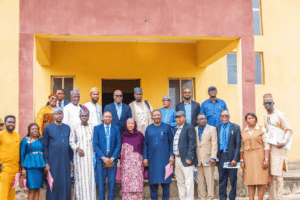
The resource verification exercise, which took place at the university’s take-off campus on Aaye-Oda Road, Akure, was led by Architect Faiza Mohammed, who commended the promoters for their investment in the development of university education.
The NUC team was received by members of the university’s Board of Trustees and management, led by the Chairman, Prof. Joseph Olorunda.
The university is expected to commence academic activities with three faculties, 12 departments and 13 degree programmes.
Recall that the Federal Government recently approved a provisional licence for Millennium Crest University, Ikare-Akoko, Ondo State, as a private university, with its take-off campus located on Aaye-Oda Road, Akure.
The Federal Government, through an approval letter issued and signed by the Executive Secretary of the NUC, Prof. Abdullahi Ribadu, to the proprietor of the university, stated that Millennium Crest University had fulfilled all the requirements stipulated in the Education (National Minimum Standards and Establishment of Institutions) Act, Cap E3, Laws of the Federation of Nigeria, 2004.
The approved faculties are the Faculty of Medical and Allied Health Sciences; Faculty of Arts, Management and Social Sciences; and Faculty of Science and Computing.
The departments include Computer Science, Nursing Science, Medical Laboratory Science, Dental Therapy, Radiography and Radiological Sciences, Community Health Science, Accounting, English Language and Literature, Economics, Social Work and International Relations.
Speaking during the resource verification exercise on Tuesday, August 25, 2026, Architect Mohammed said the assessment was aimed at determining whether the proposed university had the required physical facilities, human resources and other infrastructure to commence academic activities.
She explained that resource verification was a crucial stage in the NUC’s approval process for the establishment of a university and its proposed academic programmes.
According to her, the exercise would cover the institution’s physical structures, human capacity and ancillary facilities required to support effective teaching, learning and the overall delivery of its vision and mission.
Mohammed said the team would compare the facilities and resources provided by the university with the NUC’s minimum academic standards and core curriculum requirements.
She said, “We, as university regulators, are there to ensure that we have laid down standards that, at the end of the day, you have graduates that can be globally competitive, not only locally within the country.”
She added, “Our own duty today is resource verification. Resource verification is trying to see what you have put in place in terms of physical structures, human capacity and other ancillary facilities that could help and assist you in delivering the purpose, mission and vision of the university.”
Architect Mohammed described the establishment of a university as a capital-intensive undertaking requiring sustained commitment, saying the promoters deserved commendation for investing in education and nation-building.
She added that the exercise would be conducted according to established procedures and expressed optimism that the eventual success of the institution would be a source of pride to all stakeholders.
Earlier, the Chairman of the Board of Trustees, Prof. Joseph Olorunda, expressed deep appreciation to the NUC for its continued guidance and support throughout the institution’s development process.
He explained that the recently approved university was established as part of the promoters’ efforts to contribute to the revitalisation of university education in Nigeria.
He said the institution was conceived as a citadel of learning that would offer contemporary academic programmes in an environment designed to promote integrity, hard work and high moral and ethical standards.
Prof. Olorunda said the university would focus on the three core functions of teaching, research and community service, while striving to produce graduates and research outputs capable of competing favourably with their counterparts globally.
He added that the institution’s goals included enhancing academic quality, preparing students for a rapidly changing world, advancing innovation, promoting research and scholarship, and developing global competence and leadership.
The BoT chairman disclosed that the university had projected an annual capital expenditure of N500m on physical infrastructure at its permanent site for the next five years.
“A 25-year period of academic development, broken into three phases, has been planned for the university. At the end of the 25 years, it is planned that all faculties, departments and programmes of the university shall be in place.
“The university shall, at its full growth after 25 years of establishment, have the full complement of 71 departments and 79 undergraduate programmes and a full-fledged school of postgraduate studies.
Thus, at full maturity, 25 years after its establishment, the university shall have 12 faculties, 91 departments and 359 academic programmes, comprising 103 undergraduate programmes, 128 master’s degree programmes and 128 PhD programmes.
“The university intends to commence academic activities as soon as the report of the resource verification exercise is officially communicated to us,” he stressed.
He said the promoters were in discussions with financial partners and banking institutions, adding that commitments had been received towards funding and sustaining the university.
Prof. Olorunda also disclosed that the university had signed a memorandum of understanding with the University of Medical Sciences, Ondo, to use its well-equipped facilities for the next five years, particularly to address accommodation and other infrastructural needs during the take-off period.
He said, “Presently, we have the capacity to absorb over 1,000 students,” adding that the institution would recruit qualified and competent academic staff in line with NUC requirements and maintain the prescribed lecturer-to-student ratio.
On its mode of operation, Olorunda said the university would leverage technology to enhance teaching and learning, noting that it currently had approximately 300 functional computer units at its ICT building and departmental levels.
He said the institution planned to adopt an 80 per cent physical and 20 per cent hybrid learning model, particularly for non-clinical programmes, while its academic development would be implemented in phases over 25 years.
Prof. Olorunda assured the commission that all observations and recommendations arising from the exercise would be immediately addressed.
Also speaking, the Vice-Chancellor of the university, Prof. Wasiu Adebimpe, assured the NUC team that the university had mobilised substantial resources and facilities to meet the requirements for the commencement of its academic programmes.
Prof. Adebimpe said the institution had prepared the necessary application and academic documents for the exercise and would document the observations and recommendations of the verification team.
He pledged that the management would implement the NUC’s recommendations, stressing that they were aimed at strengthening the institution and protecting the interests of prospective students.
The epoch-making event was attended by other members of the university’s Board of Trustees, including Dr Ayodele Mesuleya, Dr Ayoola Bello and Prof. Mark Okeji.